
Deepfake Scam Ads Targeting Mexico Grew 4x in Under a Year
Revelum detected a fourfold increase in deepfake-enabled scam ads referencing Mexico between November 2025 and August 2026 — fake AI-trading platforms, cloned news broadcasts, forged government and bank branding, and impersonated public figures. Here's what the data shows and how the scam scripts actually work.
Between November 2025 and August 2026, the volume of deepfake-enabled scam ads referencing Mexico grew roughly four-fold, from around 2,000 ads a month to more than 8,300. The ads clone the voices and faces of trusted institutions, public figures, and business leaders, from Mexico’s central bank to its biggest telecom brands to its sitting president, to sell fake investment platforms, cloned casino sites, and forged government programs. Here’s what the data shows and how the scam scripts actually work.
The findings at a glance:
- ~2,000 → ~8,300 monthly detected ads referencing Mexico, November 2025 to August 2026 — roughly a 4.2x increase
- 2,527 ads impersonated BBVA and its legacy Bancomer brand — the most-impersonated bank
- 2,421 ads used casino and betting brand names — the second-largest cluster we found
- 2,071 ads cloned the on-screen branding of Mexican news outlets to make a fake pitch look like a news report
- 1,094 ads cloned the voice and image of Mexico’s sitting president, Claudia Sheinbaum
How Fast It’s Growing
Monthly deepfake ad volume targeting Mexico rose from 1,976 in November 2025 to 8,310 in August 2026, a roughly 4.2x increase in ten months.
Revelum Detection Data
Deepfake scam ads targeting Mexico: monthly volume
Nov 2025 to Aug 2026
Source: Internal Revelum
The trajectory isn’t a straight line, but the direction is unmistakable: August’s volume is more than four times November’s, with the two strongest months (May and August) both arriving after a visible dip, consistent with the pattern we’ve seen elsewhere in the region — campaigns scale, get disrupted or exhausted, and a new wave replaces them at higher volume. It mirrors the broader trend we’ve tracked globally, where deepfake fraud attempts are up 700% year over year, and fits the wider pattern of deepfake attacks across Latin America.
Who and What Gets Cloned
The ads don’t need a celebrity to work — they need something the target trusts. Between January and August 2026, that trust got borrowed from banks, government agencies, the country’s largest conglomerate, the news media, business leaders, the president herself, and even casino brands.
Financial institutions. BBVA, together with its legacy Bancomer branding, appears in 2,527 ads — the single most-impersonated financial brand we found. Santander, Banorte, HSBC, Citibanamex, and Mastercard/Visa branding all show up as well, each lending a scam script instant financial credibility.
Casino and betting brands. 2,421 ads used casino-branded pages — the second-largest cluster we found. Several borrow the name of a well-known Mexican musician or boxer as their casino’s brand name, a small but telling detail about how localized these operations get.
News broadcasting. 2,071 ads carry the on-screen branding of Mexican news outlets — N+ and Foro TV chief among them. This isn’t about the news content itself; it’s a visual trick. Wrapping a pitch in a familiar news channel’s watermark and layout signals “this was reported,” even when the actual video underneath is an unrelated sales pitch.
Government and regulatory authority. 2,046 ads invoke Banco de México, Gobierno de México, the SAT (Mexico’s tax authority), or the Secretaría de Hacienda y Crédito Público — Mexico’s finance ministry. These scripts typically claim a program is “backed” or “certified” by one of these bodies, none of which endorse private investment platforms.
Fake “AI-powered” trading platforms. 1,271 ads promoted invented trading algorithms with names like “QuantiaGPT” and “Quantum AI,” borrowing the general aura of AI credibility rather than any real institution’s name.
Well-known business executives. Several of Mexico’s most recognized business leaders are being cloned at significant, sustained scale — not one-off mentions, but dedicated campaigns built around their names and faces. Revelum has already identified exactly who, and how many ads each one appears in. We’re not publishing that list in this piece, but if your organization’s leadership fits this profile, we can tell you directly what we’re seeing.
Mexico’s head of state. President Claudia Sheinbaum’s voice and likeness have been cloned in roughly 1,094 ads so far in 2026 — a reminder that public office offers no immunity from this kind of impersonation.
Mexico’s largest business conglomerate. Grupo Carso, Telcel, Telmex, and América Móvil together appear in 1,041 ads, the smallest of the clusters we measured but still a meaningful, sustained pattern. These are the core brands of Mexico’s most prominent business group, and the pattern reflects something we see elsewhere in the region: a scam script borrows whichever locally trusted commercial name is on hand, sometimes without any real connection to what it’s actually selling.
How the Scam Actually Works: One Script, Different Costumes
Reading the ad scripts side by side, the wrapper changes constantly — an “AI trading algorithm,” a “government-backed program,” a news broadcast — but the underlying pitch barely does.
The AI-trading version opens with a cloned voice claiming to be “the richest man in the country,” announcing a new platform built on an AI model (“smarter than ChatGPT,” one script says) that guarantees daily trading profits. It even claims a fabricated endorsement from Elon Musk for extra credibility. The ask: a minimum deposit of 3,900 Mexican pesos, in exchange for a promised 150,000 pesos a month in “risk-free” returns. The script manufactures urgency with a hard cap (“only 15,000 spots”) and a countdown (“the offer closes before the end of the week”).
The government-backed version swaps the narrator for a supposedly public-spirited businessperson who claims the program has “the backing of Banco de México” and has nothing to do with cryptocurrency or pyramid schemes — the exact disclaimers a viewer would want to hear before handing over money. It promises 30,000 pesos a week, framed as “statistically possible,” not a guarantee (a thin legal hedge that does nothing to change what the pitch is actually selling). The video is engineered to be watched only once: “if you leave this page, you can’t come back.”
The news-broadcast version does something different: it doesn’t try to look credible through its script, it borrows credibility from the wrapper. The pitch inside can be anything, including graphic, testimonial-style “miracle cure” health pitches that have nothing to do with finance. Wrapping any pitch in a trusted news channel’s on-screen branding is enough to make it read as vetted, independent of what’s actually being said.
Underneath the costume, every version converges on the same funnel: borrow trust, ask for a modest deposit calibrated to feel affordable, promise a return no legitimate product could sustain, and close with human contact — a phone call from a supposed “advisor” — because that’s where the real pressure gets applied. This is the exact structure we break down in the deepfake ad fraud playbook.
See It for Yourself
The images below are fabricated, AI-generated content created by scammers. They’re included here strictly to illustrate how these campaigns actually look, so readers can learn to recognize them. None of the platforms, endorsements, or claims shown are real, and none are affiliated with Revelum or the people and outlets whose names and likenesses were stolen to make them.
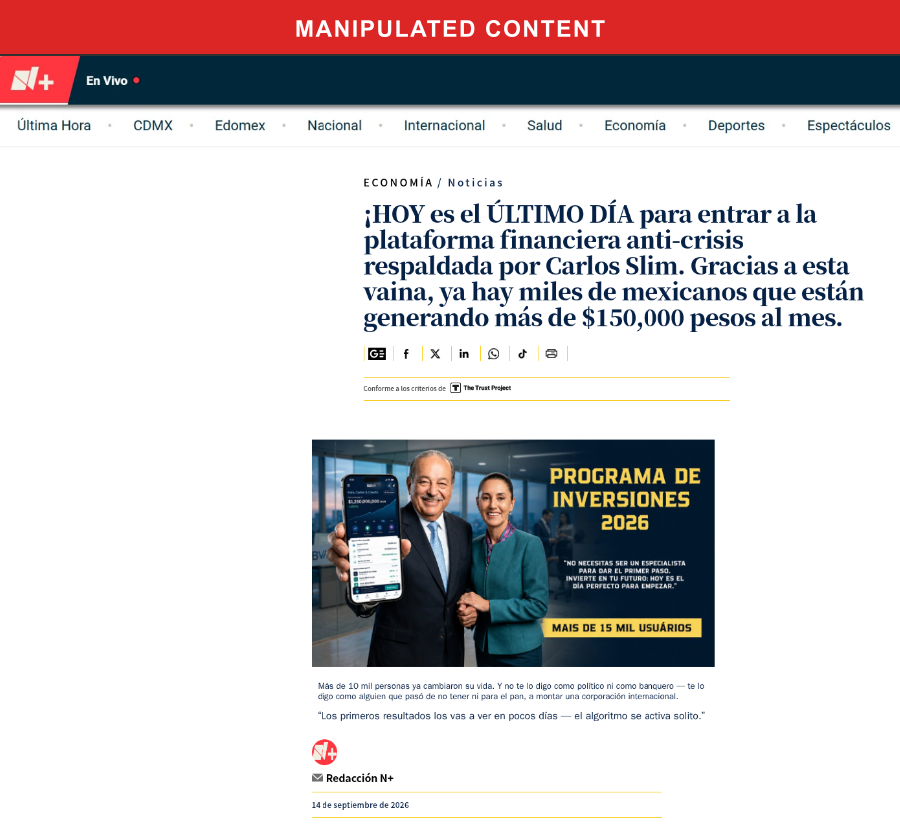
A fake N+-branded article claims a financial platform is personally backed by a well-known Mexican businessman, with a fabricated “last day to join” deadline driving urgency.
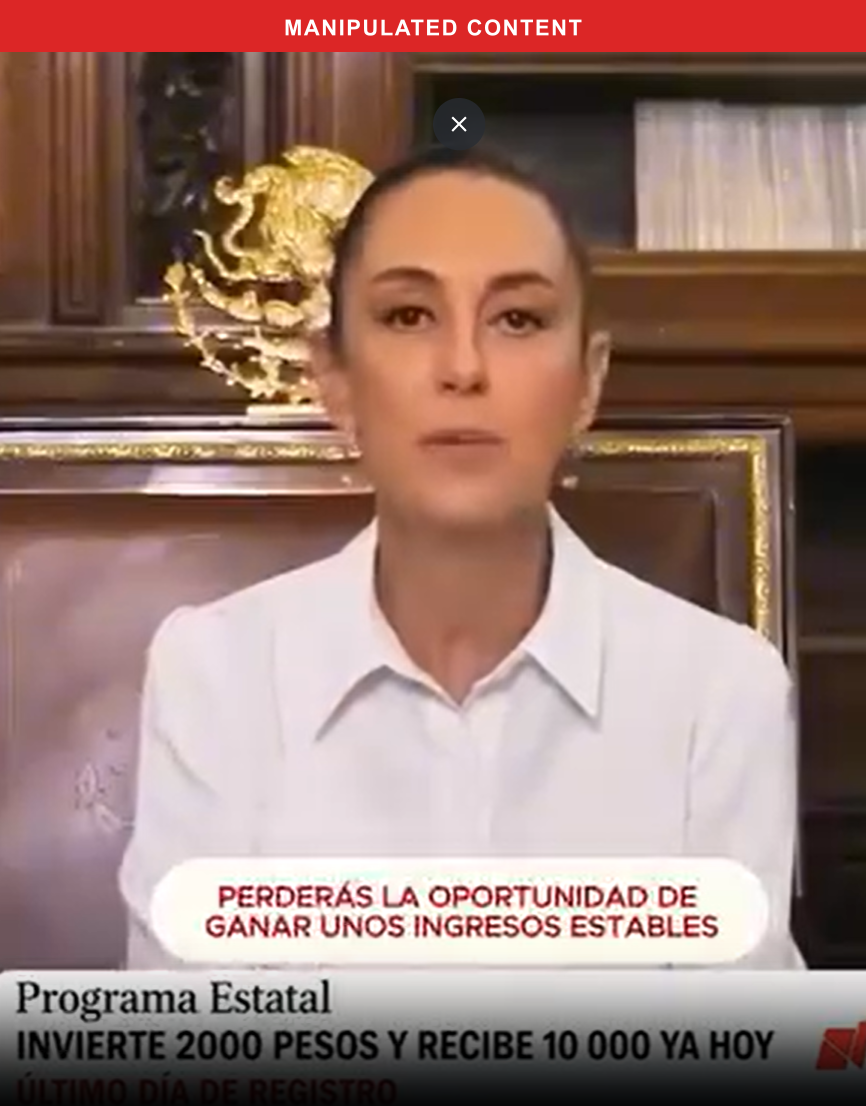
A deepfake video clones President Claudia Sheinbaum’s likeness to front a fake “Programa Estatal,” with on-screen urgency pushing viewers to register immediately.
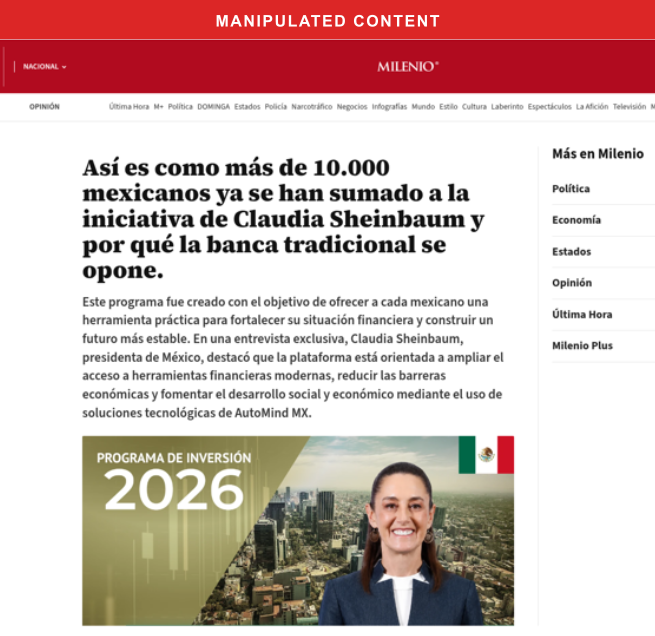
A fake Milenio-branded article walks readers through how the fabricated platform supposedly works, lending the pitch a veneer of journalistic credibility.
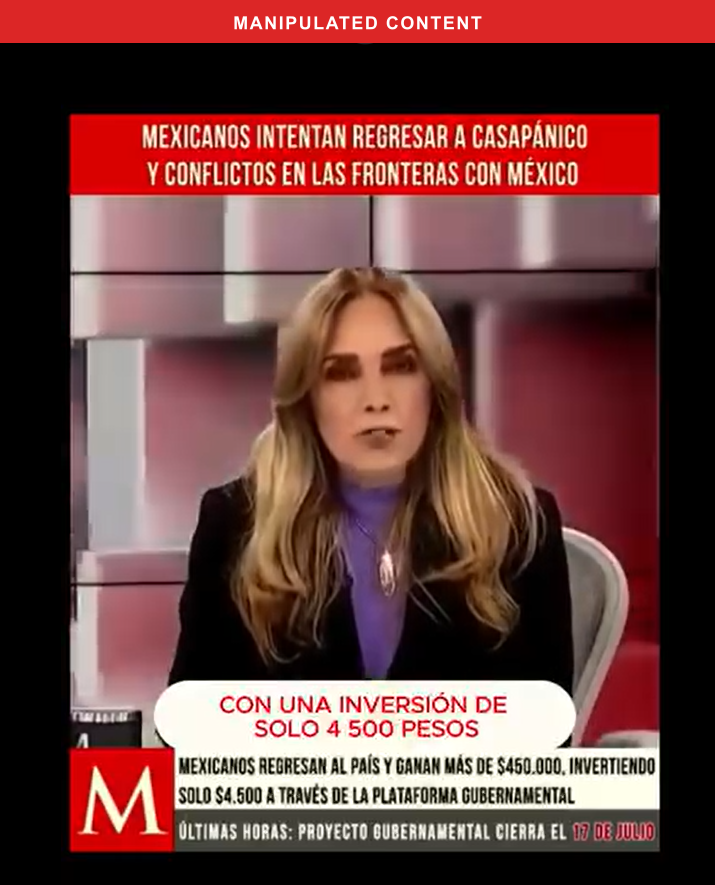
A deepfake newscast borrows Milenio’s on-screen branding and a fabricated presenter to sell the same fake government-backed platform, again framed against a closing deadline.
What To Do If You See One of These Ads
Don’t engage. Don’t click, don’t deposit money, and don’t share it, even to warn others — sharing still spreads it.
No official body sells investments through social ads. Banco de México, the SAT, and every regulated Mexican bank operate through their own official channels, never through a video ad promising guaranteed daily returns.
Coverage doesn’t remove content. Public awareness helps people avoid falling for a given ad, but campaigns keep running and scaling regardless — media coverage barely dents a deepfake’s actual attack surface. Only sustained detection and takedown work shrinks the numbers; see detection vs. removal and how the takedown process works.
If it’s you or your organization being cloned, assume it’s already scaling. The gap between when a campaign starts and when someone notices is exactly where the damage compounds.
What Revelum Does
Revelum detects and removes deepfakes at scale, monitoring advertising and social platforms across Latin America for synthetic media that impersonates executives, public figures, and financial institutions, then filing and tracking takedowns until the content, pages, and domains are gone. We have a proven track record of stopping these campaigns at the source: in past engagements, new-ad volume has fallen by as much as 98% within weeks of takedown work beginning. The data behind this report came from that same infrastructure.
If the person you need to protect is the principal of a business family, see our page on deepfake protection for family offices and high-net-worth individuals.
We’ll assess your situation and tell you what we’re seeing, typically within 24 hours.
Revelum is a deepfake detection and removal service operating globally, with a focus on the Americas and Europe. We protect executives, public figures, political leaders, and organizations from AI-generated disinformation and fraud.
This data comes from Revelum’s own ongoing monitoring, which is not exhaustive: more deepfake activity almost certainly exists beyond what is captured here, and the figures above should be read as a representative sample rather than a final count.
Disclaimer: This article is intended for informational purposes only and does not constitute legal advice. Every situation is different, and we strongly recommend consulting a qualified legal professional for guidance specific to your circumstances. Revelum’s services are operational in nature and do not replace legal counsel.
Frequently asked questions
- How many deepfake scam ads are targeting Mexico?
- Revelum detected roughly 8,300 fraudulent ads referencing Mexico in August 2026 alone, up from around 2,000 in November 2025 — a four-fold increase in under a year. This comes from Revelum's own monitoring, which is not exhaustive, so more cases are almost certainly out there.
- What institutions and public figures are being impersonated in Mexico's deepfake scam ads?
- Between January and August 2026, BBVA and its legacy Bancomer branding appeared in roughly 2,527 ads, the single most-impersonated banking brand. Casino and betting brands appeared in about 2,421 ads, Mexican news outlets (N+, Foro TV) were cloned in about 2,071 ads used as a visual credibility layer, and government and financial-authority branding (Banco de México, Gobierno de México, SAT, the Finance Ministry) appeared in about 2,046 ads. Fake "AI-powered" trading platforms appeared in about 1,271 ads, President Claudia Sheinbaum's voice and likeness were cloned in roughly 1,094 ads, and Mexico's Telcel, Telmex, América Móvil, and Grupo Carso brands appeared in about 1,041 ads. Revelum has also identified, by name, the specific well-known business executives being cloned, though that list isn't published in this piece.
- Is the video of Claudia Sheinbaum promoting an investment platform real?
- No. Revelum's detection systems found more than 1,000 deepfake ads in the first eight months of 2026 that clone President Claudia Sheinbaum's voice and likeness to promote fake investment programs, including one styled as a "Programa Estatal." The Mexican government does not endorse or promote private investment platforms through social media ads. Any video of a public official promising guaranteed daily or weekly returns is fabricated.
- How do Mexico's deepfake investment scam ads work?
- Nearly every script follows the same structure regardless of which institution or persona it borrows credibility from: a cloned voice claims to have built an AI-powered trading platform, cites a trusted authority (a central bank, a regulator, or a famous businessperson) for legitimacy, asks for a small upfront deposit — commonly a minimum of 3,900 Mexican pesos — and promises implausible guaranteed returns, in some cases over 150,000 pesos a month. The close is usually a phone call from a supposed "advisor."
- What should I do if I see a deepfake scam ad referencing a public figure or institution I trust?
- Do not click, deposit money, or share it. No central bank, regulator, or ministry endorses private investment platforms through social media ads, and no legitimate financial product guarantees fixed, risk-free daily or weekly returns. Report the ad to the platform it's running on, and if you or your organization is the one being impersonated, get the content documented and taken down rather than waiting for the campaign to burn out on its own.